Paintings
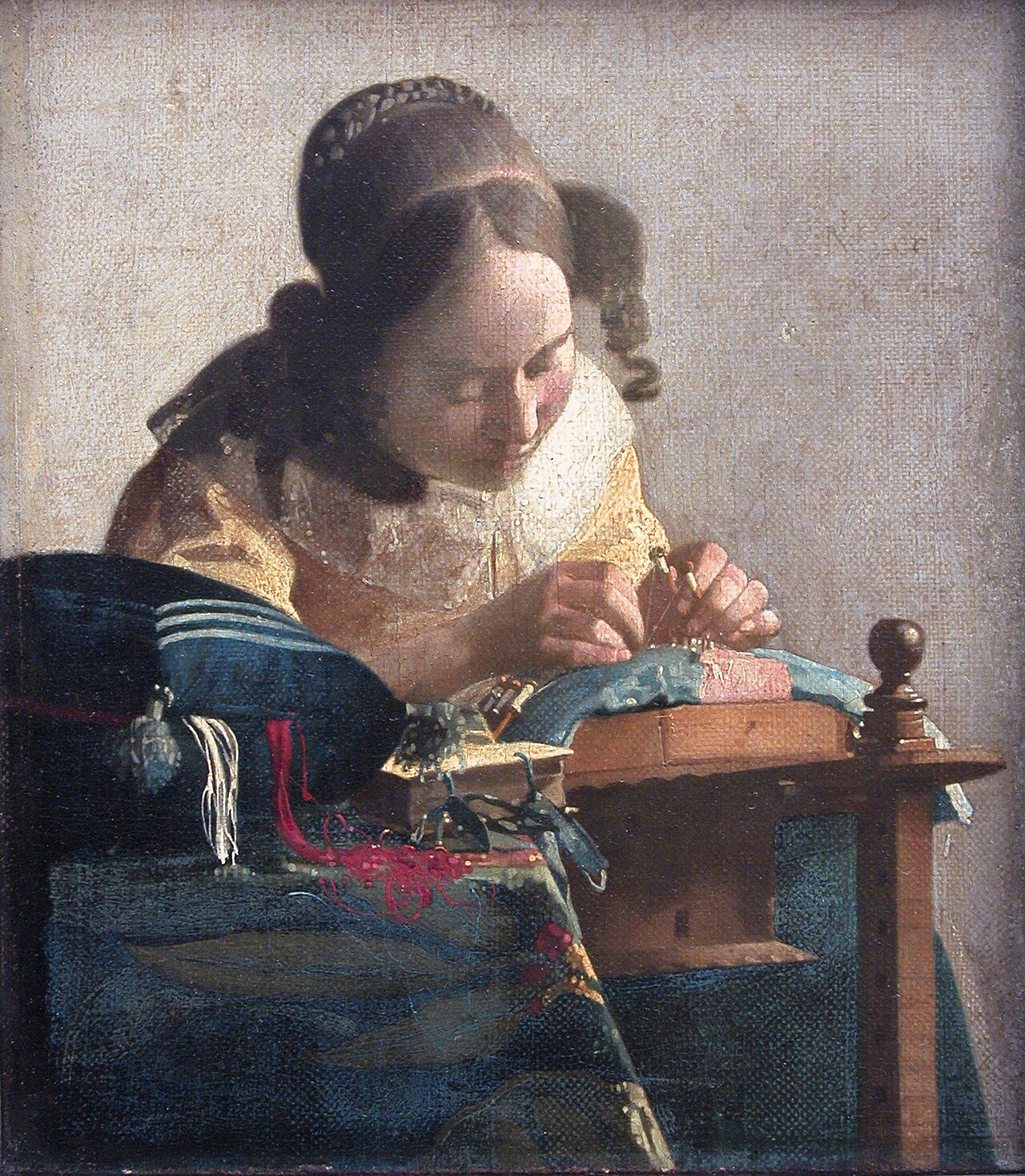
The Lacemaker
Johannes Vermeer
c. 1669–1670
A young woman bends in intense concentration over her bobbin lace, her hands poised with delicate precision. Vermeer softens the background while rendering the red and white threads in the foreground as blurred points of light. It is one of the smallest yet most intimate paintings in the Louvre.
Historical Context
Painted in Delft during the Dutch Golden Age, the work shows the quiet domestic virtue prized in Dutch society. Vermeer’s experiments with optical effects, possibly influenced by the camera obscura, are evident in its selective focus. Salvador Dalí famously admired the picture and even brought a rhinoceros to the Sorbonne to lecture on it.
Provenance
Sold in Amsterdam in 1696 and passed through several private collections. It was bought by the French state in 1870 and entered the Louvre.
Details
- Medium
- Oil on canvas mounted on panel
- Dimensions
- 24.5 × 21 cm
- Department
- Paintings
- Period / Era
- Baroque & Rococo
- Origin
- Netherlands (Delft)
- Location in museum
- Richelieu Wing, Second Floor — Room 837
About the Artist
Johannes Vermeer
Johannes Vermeer (1632–1675) lived and worked in Delft, producing only around 35 known paintings. Renowned for luminous light and serene interiors, he was largely forgotten after his death until his rediscovery in the nineteenth century.