Paintings
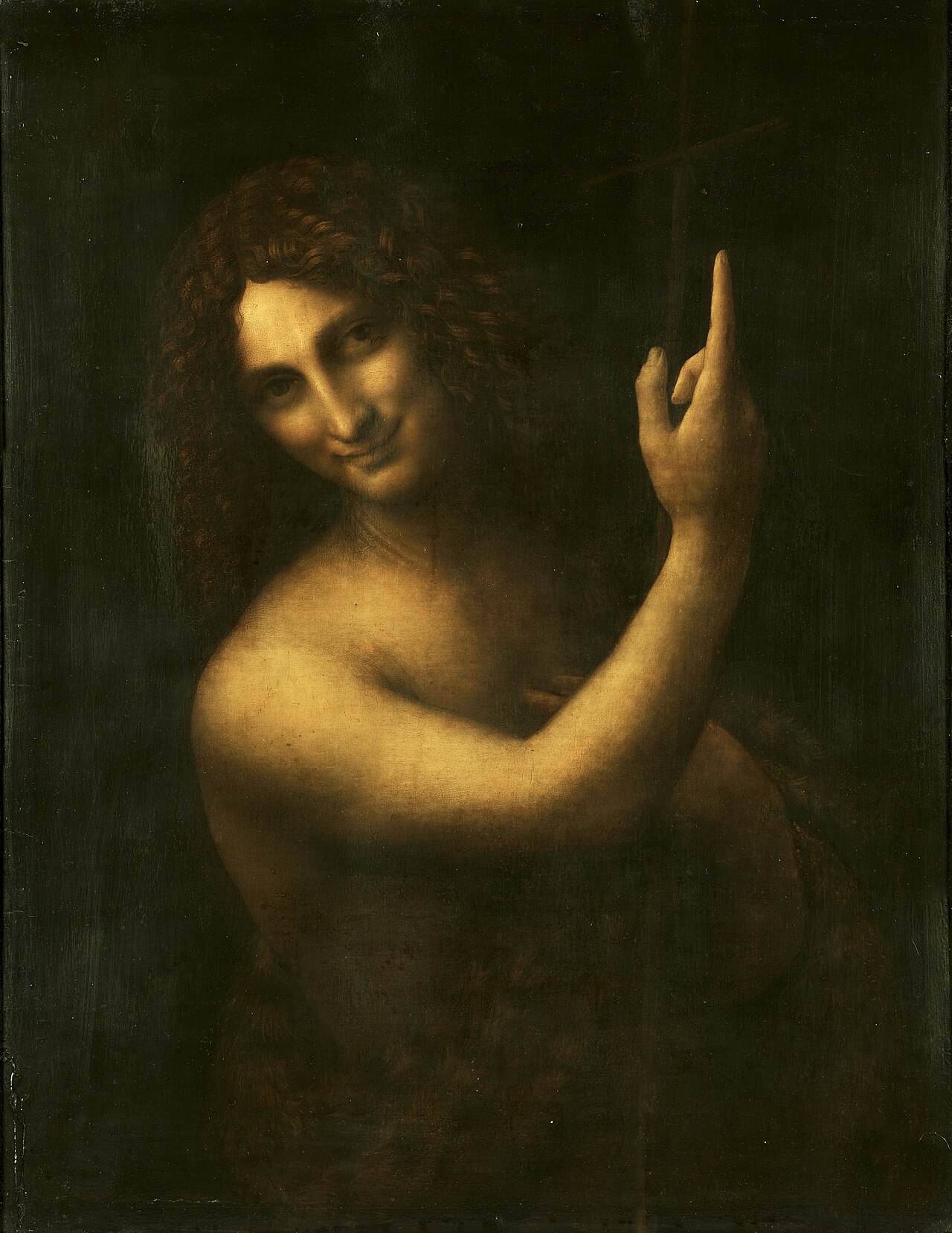
Saint John the Baptist
Leonardo da Vinci
c. 1513–1516
Emerging from a dark background, Saint John smiles enigmatically and points toward heaven with his right hand. His curls and soft, androgynous features are modelled in Leonardo’s subtle sfumato. It is the last known painting by the artist and is often described as an unsettling and deeply personal work.
Historical Context
Leonardo probably painted it in Rome or in France in his final years. It later became known as the source of the pointing gesture that recurs in other works, such as The Virgin and Child with Saint Anne. The traditional iconography of the camel-hair robe and cross-shaped staff is reduced to a bare minimum.
Provenance
Recorded in the collection of Charles I of England, sold after his execution, and acquired by Louis XIV in 1662.
Details
- Medium
- Oil on walnut panel
- Dimensions
- 69 × 57 cm
- Department
- Paintings
- Period / Era
- Renaissance
- Origin
- Italy / France
- Location in museum
- Denon Wing, First Floor — Grande Galerie
About the Artist
Leonardo da Vinci
Leonardo da Vinci (1452–1519) spent his final years in France at the invitation of Francis I. His late work shows increasing psychological depth and smoky, ambiguous modelling.