Paintings
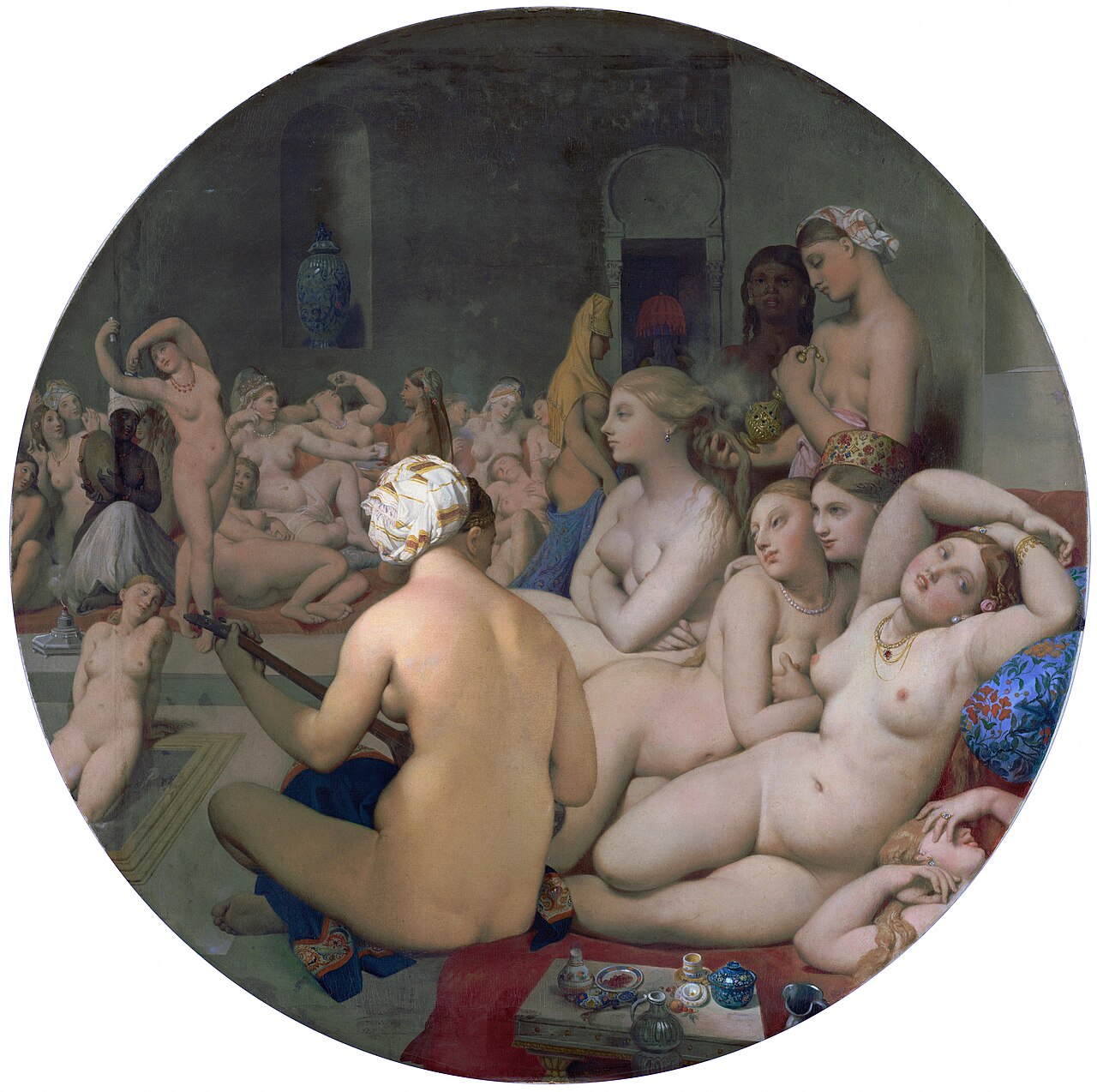
The Turkish Bath
Jean-Auguste-Dominique Ingres
1862
This circular painting shows a crowd of nude women in an imagined harem bath, their sinuous bodies filling the round frame. The composition draws on earlier Ingres studies, including the figure seen from behind playing a stringed instrument. Its shape suggests a voyeur peeping through a keyhole and reflects the nineteenth-century fascination with Orientalism.
Historical Context
Painted by Ingres when he was 82, the picture is a summation of his lifelong obsession with the female nude. Its imagery came from travel literature rather than direct observation, as Ingres never visited the Middle East. Originally rectangular, it was converted to a tondo at his request.
Provenance
Made for Prince Napoléon, who returned it because his wife found it improper. It later passed through private collections, including that of Khalil Bey, and was acquired by the Louvre in 1911.
Details
- Medium
- Oil on canvas mounted on panel (tondo)
- Dimensions
- 108 cm diameter
- Department
- Paintings
- Period / Era
- Romantic
- Origin
- France
- Location in museum
- Sully & Richelieu Wings, Upper Floors — French paintings galleries
About the Artist
Jean-Auguste-Dominique Ingres
Jean-Auguste-Dominique Ingres (1780–1867) was a pupil of David and the great champion of line and classical form in French painting. Though known as a Neoclassicist, his sensuous distortions and exotic subjects show a Romantic sensibility.