Egyptian Antiquities
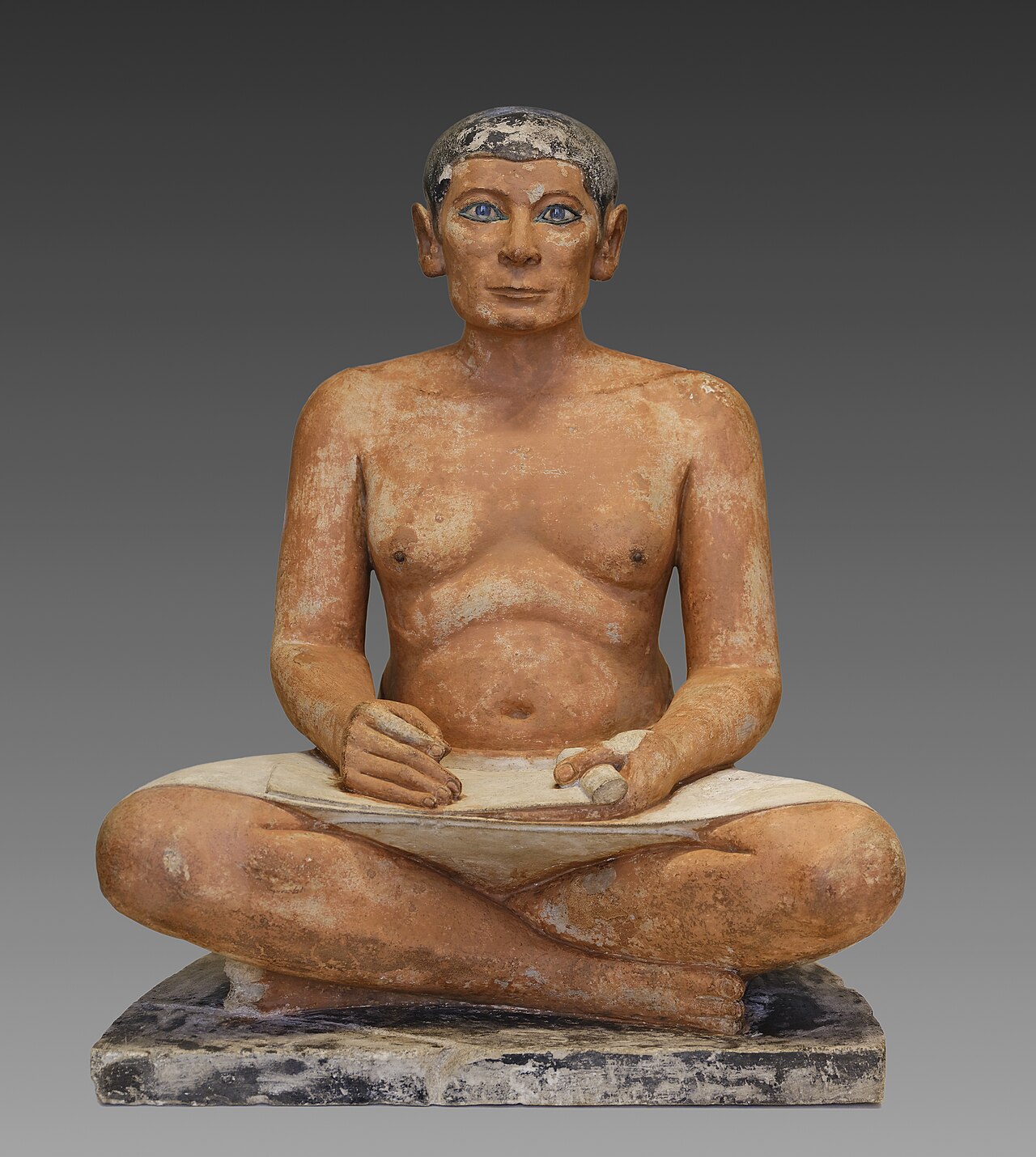
The Seated Scribe
Egyptian sculptor (unknown)
c. 2620–2500 BC
The scribe sits cross-legged with a papyrus unrolled across his lap, his hand poised to write. His inlaid eyes give the face an astonishingly lifelike gaze, and the soft, slightly sagging torso shows a man of comfortable status rather than an idealised youth. It is regarded as one of the masterpieces of Egyptian art.
Historical Context
Scribes held a privileged position in ancient Egypt because literacy was rare and essential to administration. The statue was probably placed in a tomb near the pyramids to serve its owner in the afterlife. The identity of the man is unknown, though his realism suggests an important official.
Provenance
Found in 1850 by Auguste Mariette at Saqqara, near the pyramid of Djoser, and taken to the Louvre.
Details
- Medium
- Painted limestone with inlaid eyes of rock crystal, magnesite and copper
- Dimensions
- 53.7 × 41 cm
- Department
- Egyptian Antiquities
- Period / Era
- Ancient
- Origin
- Egypt (Saqqara)
- Location in museum
- Sully Wing, Ground Floor — Old Kingdom galleries
About the Artist
Egyptian sculptor (unknown)
The sculptor is anonymous, as was typical in the Old Kingdom, when artists worked within workshops attached to the royal court and temples. The lifelike style of the Fourth Dynasty produced some of the finest portrait statues of the ancient world.