Sculpture
The Dying Slave
Michelangelo Buonarroti
1513–1516
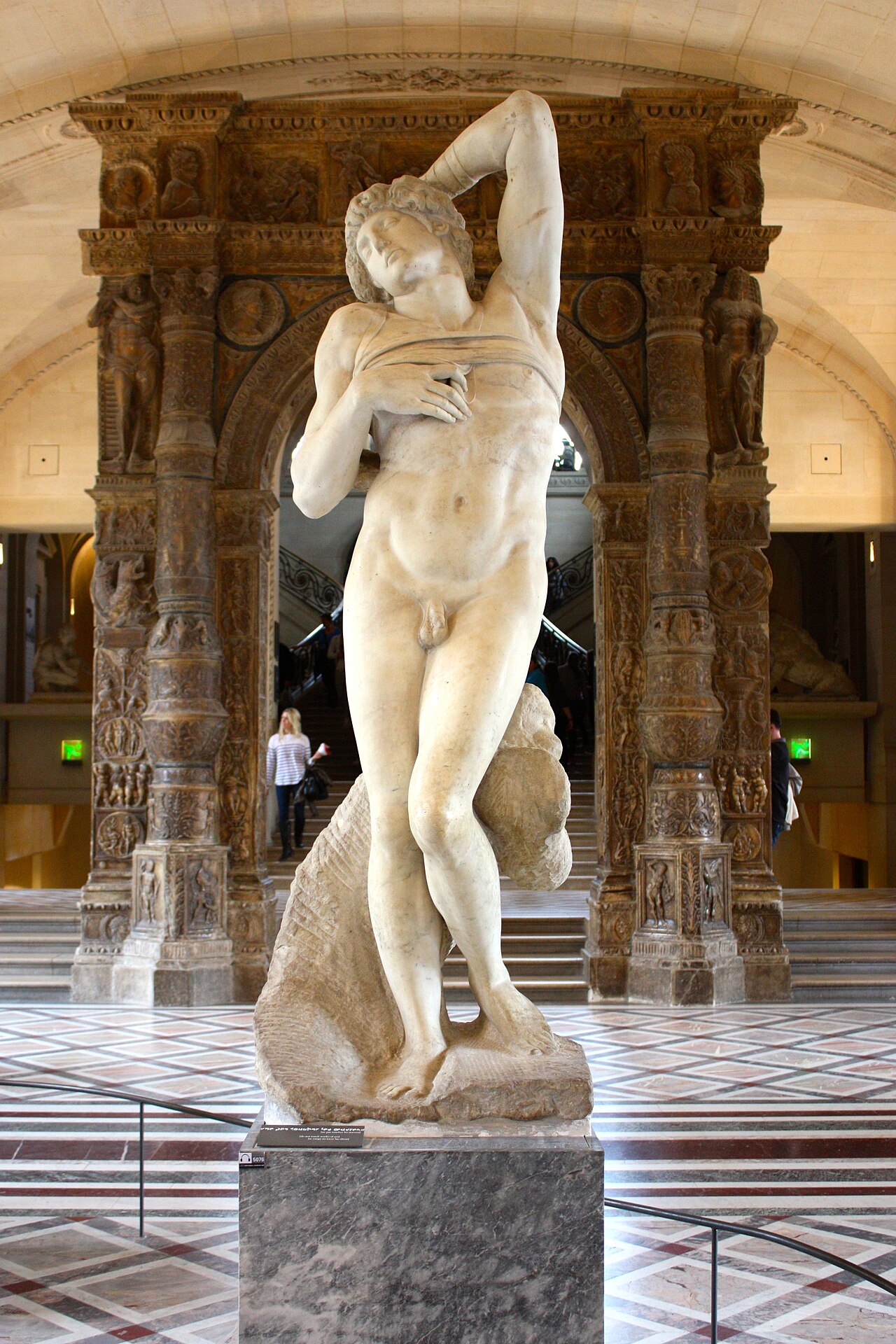
A young male nude twists with his head thrown back and one arm crossing his chest, caught between surrender and struggle. Whether he is dying or emerging from sleep has long been debated. The polished body against the rough-hewn marble block behind conveys Michelangelo’s belief that the figure already lay within the stone.
Historical Context
It was designed for the monumental tomb of Pope Julius II in Saint Peter’s, a project that plagued Michelangelo for decades and was drastically scaled down. Together with its companion the Rebellious Slave, it is one of two finished figures now in the Louvre. The other Slaves remain unfinished in Florence.
Provenance
Given by Michelangelo to Roberto Strozzi, who presented it to King Francis I of France. Entered the Louvre after the Revolution.
Details
- Medium
- Marble
- Dimensions
- 229 cm high
- Department
- Sculpture
- Period / Era
- Renaissance
- Origin
- Italy (Rome)
- Location in museum
- Denon Wing, Ground Floor — Room 403 (Michelangelo Gallery)
About the Artist
Michelangelo Buonarroti
Michelangelo Buonarroti (1475–1564) was sculptor, painter, architect and poet, creator of the David, the Sistine Chapel ceiling and the dome of Saint Peter’s. He considered sculpture his true calling and worked marble with unparalleled intensity.