Greek & Roman Antiquities
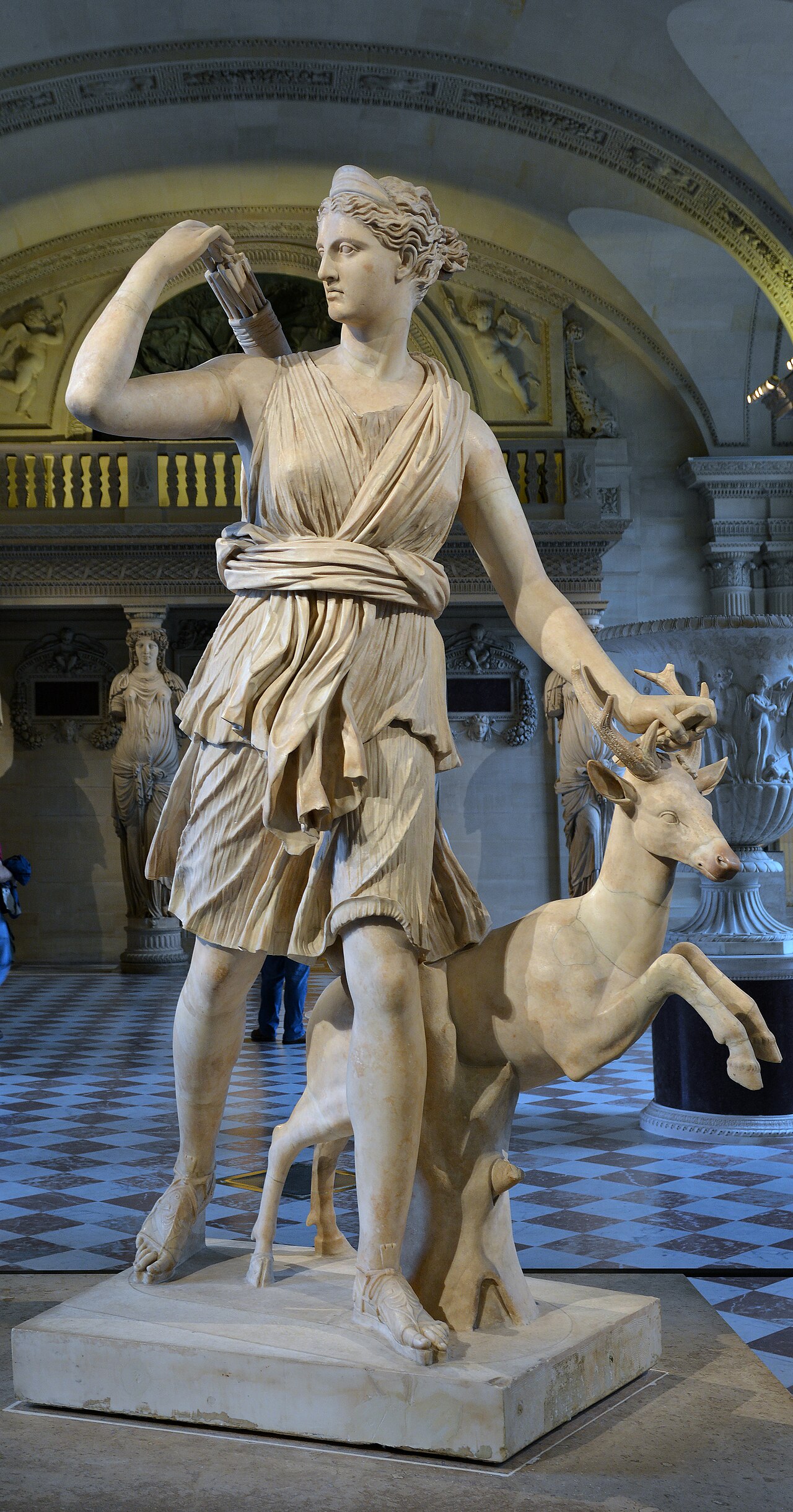
Artemis with a Doe (Diana of Versailles)
Roman copy after Leochares (attributed)
Roman copy, 1st–2nd century AD, after a c. 325 BC original
The goddess of the hunt strides forward in a short tunic, drawing an arrow from her quiver as a doe leaps beside her. The rapid motion of the figure, with her turned head and swirling cloak, gives the statue an air of alert vitality. Its graceful proportions exemplify late Classical Greek taste as transmitted through Roman copies.
Historical Context
The statue is a Roman copy of a bronze original attributed to the Greek sculptor Leochares, made about 325 BC. Pope Paul IV gave it to King Henry II of France, who installed it in a fountain at Fontainebleau, and Louis XIV later moved it to the Hall of Mirrors at Versailles. It is therefore also known as the Diana of Versailles.
Provenance
A gift of Pope Paul IV to Henry II of France in the sixteenth century; displayed at Fontainebleau and Versailles before entering the Louvre in 1798.
Details
- Medium
- Marble
- Dimensions
- Approx. 200 cm high
- Department
- Greek & Roman Antiquities
- Period / Era
- Ancient
- Origin
- Rome (after a Greek original)
- Location in museum
- Denon & Sully Wings, Ground Floor — Roman antiquities galleries
About the Artist
Roman copy after Leochares (attributed)
Leochares was an Athenian sculptor active in the fourth century BC who worked on the Mausoleum at Halicarnassus and created portraits of Alexander the Great’s family. Attribution of this composition to him rests on stylistic comparison.