Paintings
The Wedding at Cana
Paolo Veronese
1562–1563
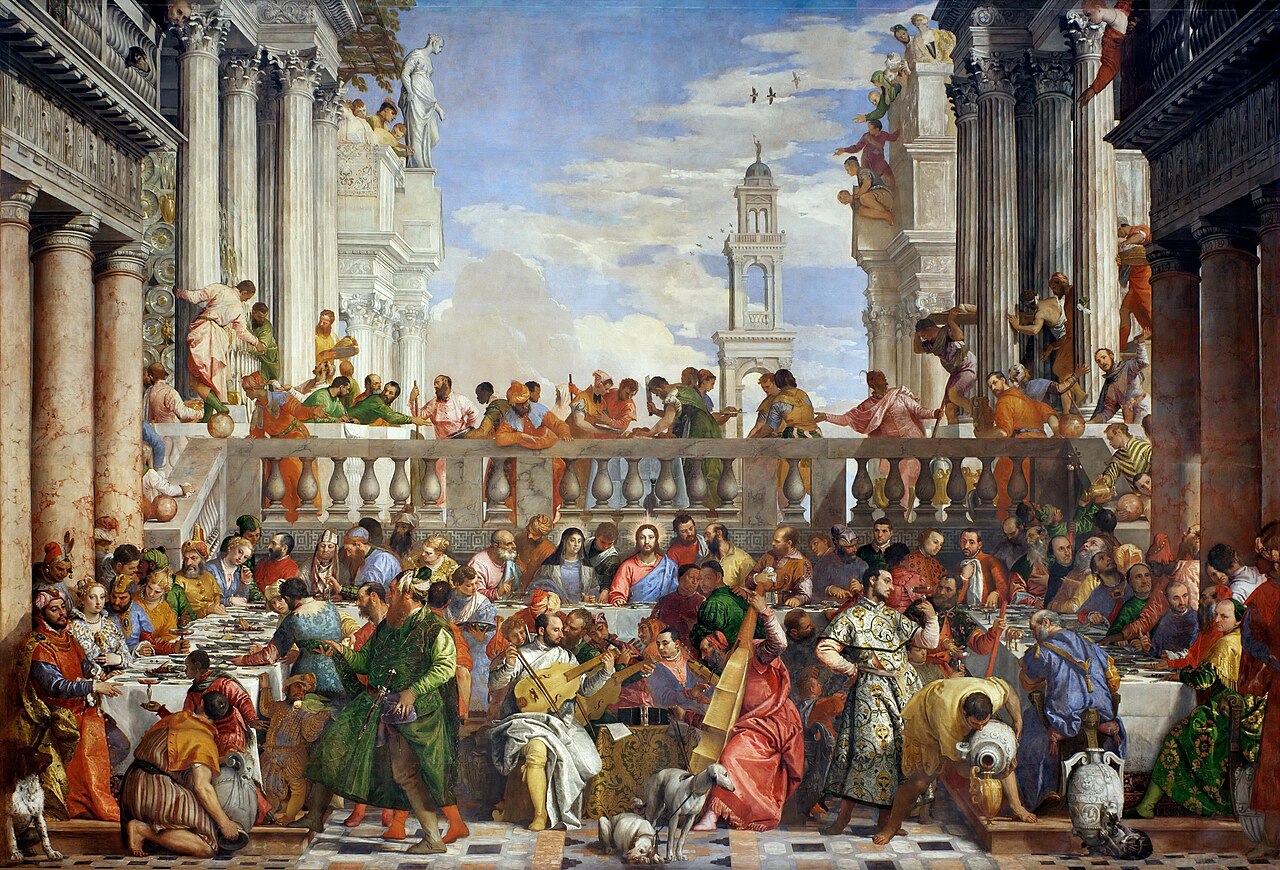
Veronese’s monumental canvas shows the Gospel miracle at Cana, where Christ turned water into wine, staged as a sumptuous Venetian banquet beneath classical loggias. Over a hundred figures fill the scene, including musicians, servants and guests in rich silks. At the centre, Christ and Mary sit quietly while a group of musicians, said to be portraits of Venetian painters, plays in the foreground.
Historical Context
The painting was created for the refectory of the Benedictine monastery of San Giorgio Maggiore in Venice. It is the largest painting in the Louvre and hangs directly across from the Mona Lisa. Its color and pageantry embody the Venetian delight in splendour.
Provenance
Removed from San Giorgio Maggiore by Napoleon’s troops in 1797 and brought to Paris. It was cut for transport and never returned to Venice; a digital copy now hangs in its original setting.
Details
- Medium
- Oil on canvas
- Dimensions
- 677 × 994 cm
- Department
- Paintings
- Period / Era
- Renaissance
- Origin
- Italy (Venice)
- Location in museum
- Denon Wing, First Floor — Room 711, opposite the Mona Lisa
About the Artist
Paolo Veronese
Paolo Veronese (1528–1588) was one of the great masters of the Venetian Renaissance alongside Titian and Tintoretto. Born in Verona, he became famed for shimmering colour, grand architectural settings and large festive banquet scenes.