Greek & Roman Antiquities
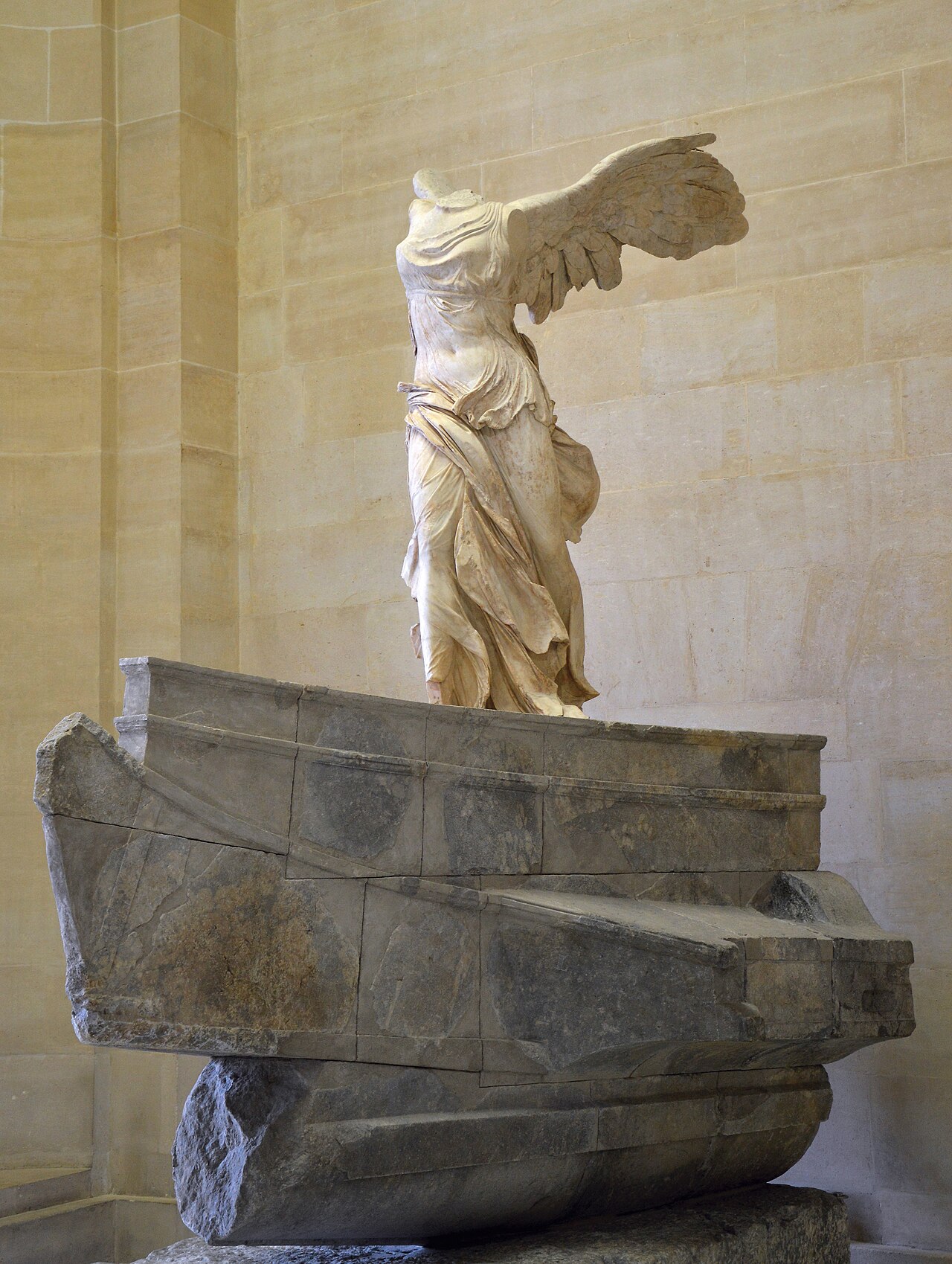
Winged Victory of Samothrace
Unknown Greek sculptor
c. 190 BC
The Winged Victory depicts Nike, goddess of victory, alighting on the prow of a warship, her wings flung back and her wet drapery pressed against her body by the sea wind. Though headless and armless, the statue radiates dramatic energy through its diagonal composition and the virtuoso carving of cloth. It is regarded as one of the greatest masterpieces of Hellenistic sculpture.
Historical Context
It was probably dedicated in the sanctuary of the Great Gods on Samothrace to commemorate a naval victory, perhaps by Rhodes. French consul Charles Champoiseau unearthed the fragments in 1863, and further pieces were found in 1950. Since 1884 it has crowned the Daru staircase, where it dominates the approach to the Denon Wing.
Provenance
Excavated in 1863 by Charles Champoiseau and shipped to Paris. The ship’s prow was reconstructed from fragments, and the right hand was found in 1950 and is displayed nearby.
Details
- Medium
- Parian marble (figure) and grey marble (ship base)
- Dimensions
- Approx. 244 cm high
- Department
- Greek & Roman Antiquities
- Period / Era
- Ancient
- Origin
- Greece (Samothrace)
- Location in museum
- Denon Wing, First Floor — Top of the Daru Staircase
About the Artist
Unknown Greek sculptor
The sculptor is unknown. Stylistic parallels suggest an artist of the Rhodian or Asia Minor schools working in the early second century BC, when Hellenistic sculptors were pushing marble to express movement and emotion.