Greek & Roman Antiquities
Venus de Milo
Alexandros of Antioch
c. 130–100 BC
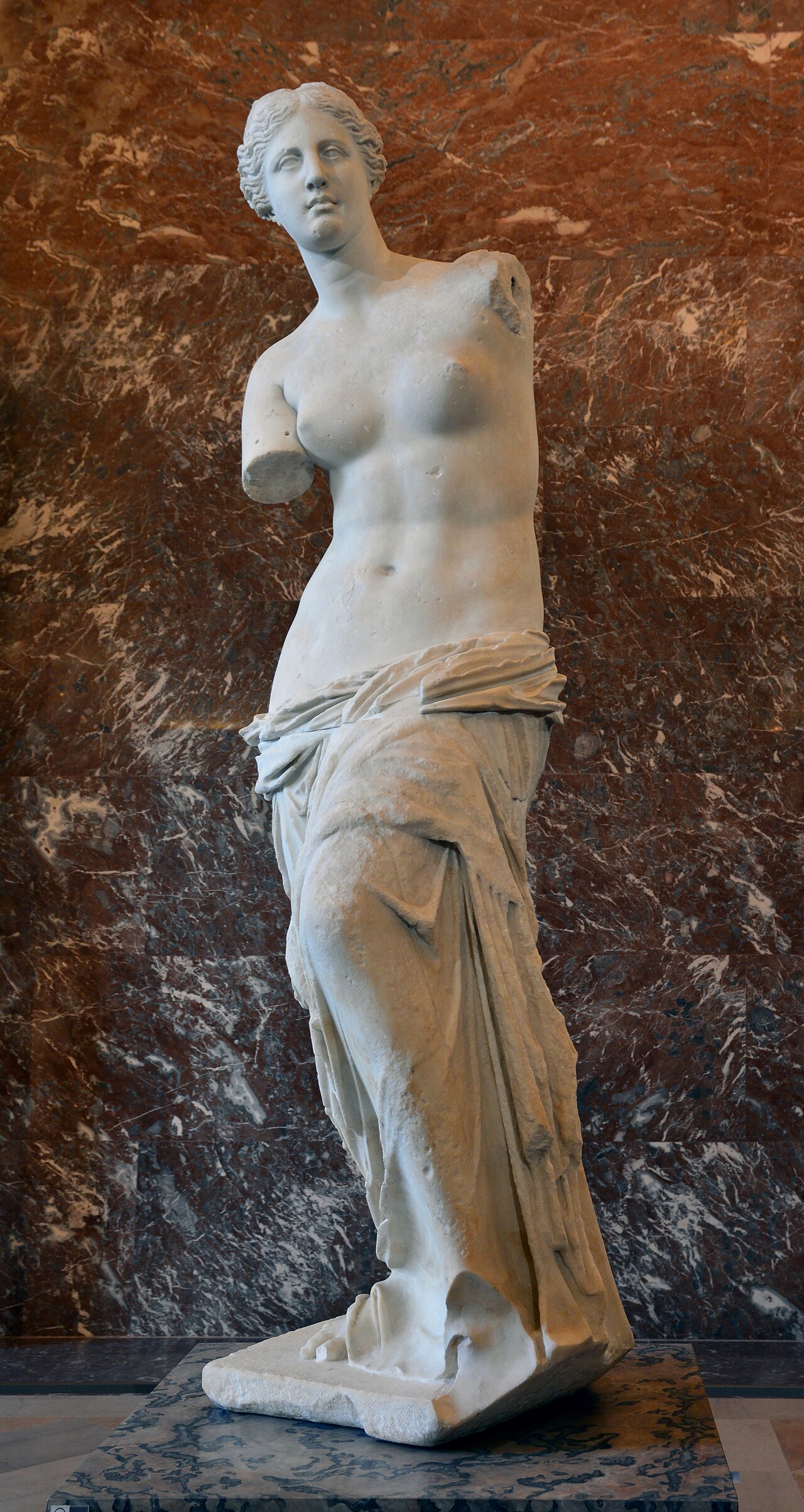
The Venus de Milo is a Hellenistic marble statue of the goddess Aphrodite, generally identified by her spiraling contrapposto stance and the drapery slipping from her hips. Both arms are missing, and scholars still debate what she originally held, whether an apple, a mirror or her slipping garment. The statue combines the idealised body of Classical Greek sculpture with the sensual movement typical of the Hellenistic age.
Historical Context
The statue was discovered in 1820 by a farmer on the Aegean island of Milos and quickly acquired through French diplomatic efforts. An inscribed plinth once credited the sculptor Alexandros of Antioch, but it was lost after discovery. Presented to King Louis XVIII, it became a treasure of the Louvre and a global symbol of classical beauty.
Provenance
Found in 1820 on Milos, purchased by the French ambassador to the Ottoman Empire, and given to Louis XVIII, who donated it to the Louvre in 1821.
Details
- Medium
- Parian marble
- Dimensions
- 202 cm high
- Department
- Greek & Roman Antiquities
- Period / Era
- Ancient
- Origin
- Greece (Island of Milos)
- Location in museum
- Sully Wing, Ground Floor — Room 345
About the Artist
Alexandros of Antioch
Alexandros of Antioch on the Meander is known almost solely from the inscription once attached to this statue. He is thought to have worked in the Hellenistic period, in a tradition that looked back to the fourth-century BC sculptors Praxiteles and Skopas.