Paintings
Mona Lisa
Leonardo da Vinci
c. 1503–1519
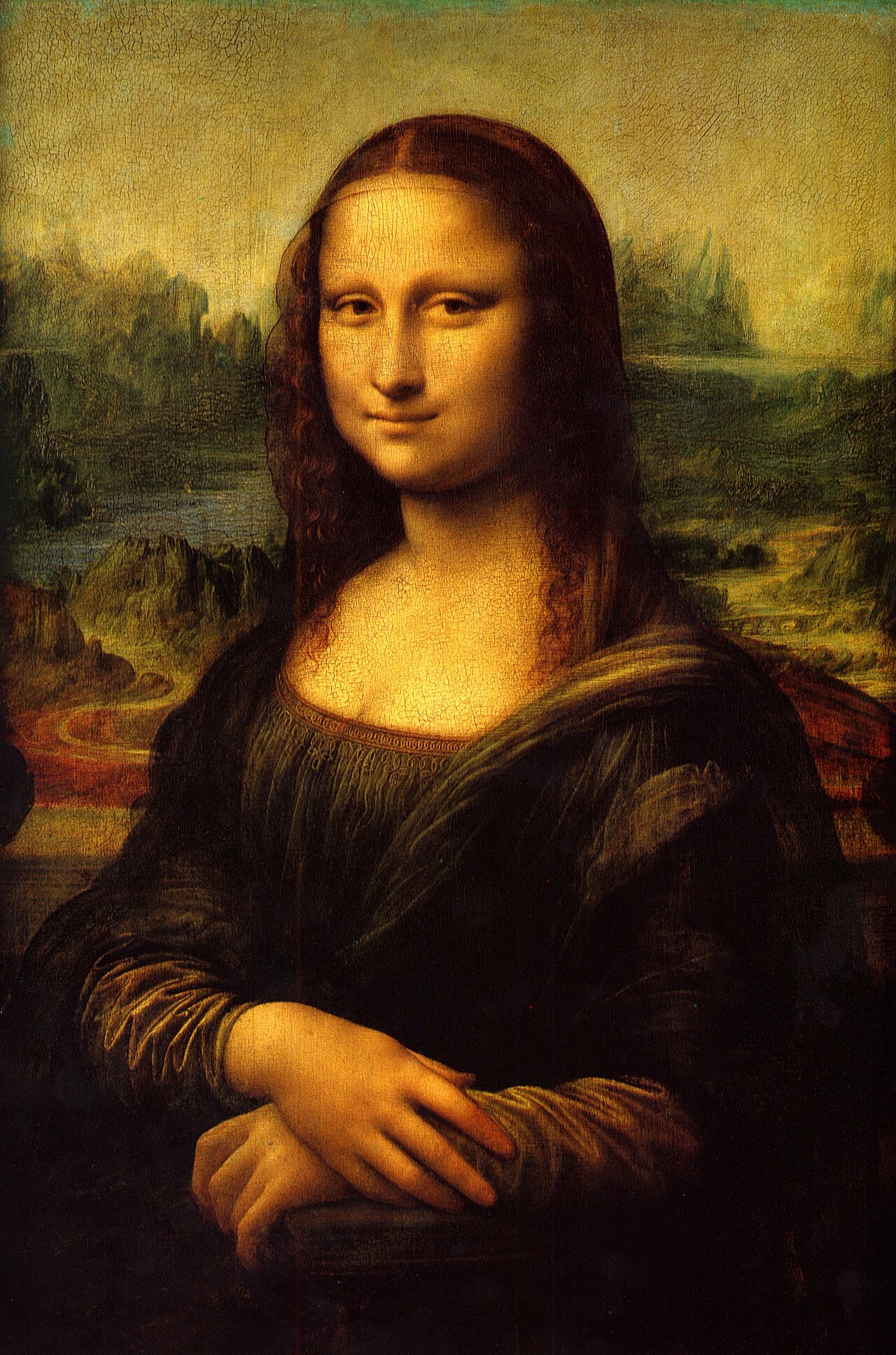
The Mona Lisa is a half-length portrait of a woman, widely identified as Lisa Gherardini, wife of the Florentine silk merchant Francesco del Giocondo. Leonardo used his celebrated sfumato technique, blending translucent glazes so that outlines dissolve into soft shadow, giving the enigmatic smile its shifting, elusive quality. Behind the sitter stretches an imaginary, atmospheric landscape of winding paths and distant water. It is arguably the most famous painting in the world.
Historical Context
Begun in Florence around 1503, the portrait was never delivered to its patron; Leonardo carried it with him to France and kept refining it for years. Its fame grew enormously after it was stolen from the Louvre in 1911 by Vincenzo Peruggia and recovered in 1913. Today it is protected behind bulletproof glass and draws millions of visitors annually.
Provenance
Acquired by King Francis I of France, probably after Leonardo’s death in 1519. It hung at Fontainebleau and Versailles before entering the Louvre after the French Revolution; Napoleon briefly displayed it in his bedroom at the Tuileries.
Details
- Medium
- Oil on poplar panel
- Dimensions
- 77 × 53 cm
- Department
- Paintings
- Period / Era
- Renaissance
- Origin
- Italy (Florence)
- Location in museum
- Denon Wing, First Floor — Room 711 (Salle des États)
About the Artist
Leonardo da Vinci
Leonardo da Vinci (1452–1519) was the quintessential Renaissance polymath: painter, engineer, anatomist and inventor. Born near Vinci in Tuscany, he trained in Verrocchio’s Florentine workshop and later worked in Milan, Rome and France. Fewer than twenty paintings are securely attributed to him, yet his notebooks reveal a mind of extraordinary range.